PD Pathogenicity Model
The Parkinson’s disease pathogenicity model (PD-PM) integrates statistical modelling and clinical knowledge to characterise disease heterogeneity across three dimensions: extent, severity, and modulation. It estimates individual PD probability and visualises patient profiles in a three-dimensional pathogenicity space. The conceptual framework was proposed by Prof. Mauno Vihinen (reference) and applied to the Luxembourg Parkinson’s (LuxPark) cohort and Luxembourg RBD study.
In these cohorts, two elastic-net logistic regression models were developed to distinguish PD from healthy controls and from individuals with isolated REM sleep behaviour disorder (iRBD). In 10 × 10-fold nested cross-validation the AUC was 0.967 (95% CI 0.960–0.975) for Control vs PD and 0.950 (0.914–0.977) for iRBD vs PD. The framework was also used to describe individuals who converted to PD during follow-up.
The predictor is freely available and requires 18 clinical parameters for Control vs PD or 13 for iRBD vs PD.
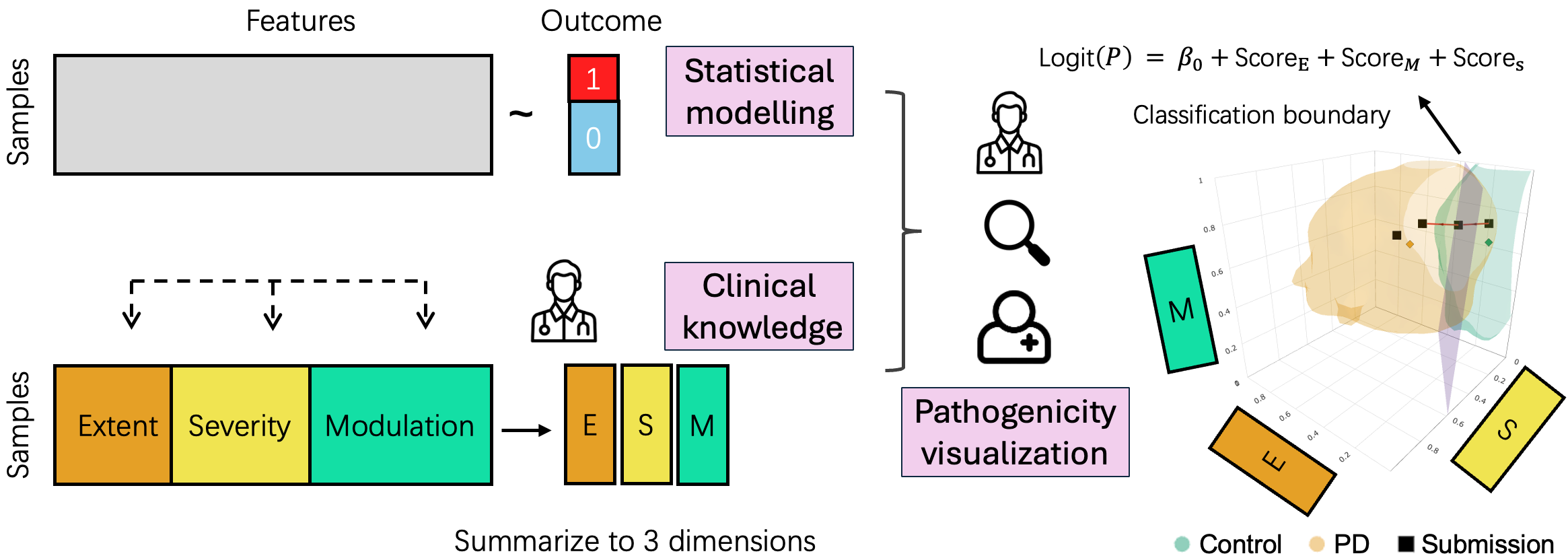
Extent
Captures the degree or breadth of PD or RBD.
Severity
Represents the extent or degree of the disease expression.
Modulation
Reflects the extent of modifier effects on disease presentation.
PD-PM Prediction
Estimate PD probability and explore individual profiles in the pathogenicity space.
Enter one individual in the form, or paste multiple rows in Batch Input.
Longitudinal follow-ups are visualised as trajectories in the 3D map.
One row per individual, comma-separated. Columns: id , visit , then the features in the order below (a header row is optional). Use the same id across visits for longitudinal data.
P(PD) is the estimated probability of PD relative to the selected comparison group. Cutoffs: Control vs PD = 0.40; iRBD vs PD = 0.65.
Shaded regions show the densest areas containing the selected percentage of each group (90% by default). Diamonds indicate group medians, and black squares represent submitted individuals. The purple plane marks the PD classification boundary. Click legend items to show or hide them.
How to Use
- Collect the required clinical parameters: 18 for Control vs PD and 13 for iRBD vs PD. See the feature table below.
- On the Prediction page, choose the comparison model, then use Single Individual for manual entry of one subject, or Batch Input to paste multiple rows as comma-separated values (id, visit, then the features; with or without a header row). An example is pre-filled.
- Click Run Prediction to obtain the estimated PD probability P(PD), the classification (PD or Non-PD), and the Extent, Severity, and Modulation scores, scaled 0–1 relative to the cohort.
- Cutoff values: Control vs PD = 0.40; iRBD vs PD = 0.65.
- Submitted individuals are shown in the 3D map (Pathogenicity Space) against the cohort, which is shown in aggregate form: for each group, the region containing a chosen share (50% to 90%, default 90%) of participants at baseline and the group median. The region is a highest-density region of a kernel density estimate (Hyndman, 1996): the smallest region holding that share of the group, so it shows how widely individuals vary and how much the groups overlap. Visits with the same id are connected as a trajectory, with arrows pointing from earlier to later visits.
Features
The table lists all clinical parameters with their group assignment and which prediction model uses each feature. ✓ = used; — = not used (zero coefficient).
| Group | Description | Used in Control vs PD | Used in iRBD vs PD |
|---|---|---|---|
| Severity | Tremor Score (Derived from MDS-UPDRS Part III Tremor Items) | ✓ | ✓ |
| Severity | PIGD Score (mean of MDS-UPDRS items 2.12, 2.13, 3.10, 3.11, 3.12; range 0-4) | ✓ | ✓ |
| Modulation | Body Mass Index (BMI) | ✓ | — |
| Modulation | Blood Pressure, Systolic (Sitting, Mean) | ✓ | ✓ |
| Modulation | History of Head Injury or Concussion (1 = Yes; 0 = Other) | ✓ | — |
| Modulation | Waist-to-Hip Ratio | — | ✓ |
| Extent | Sniffin' Sticks Odour Identification Test, Number Correct (0-16) | ✓ | ✓ |
| Extent | Trail Making Test Part A (TMT-A), Time to Completion | ✓ | — |
| Extent | Trail Making Test Part B (TMT-B) not completed within 5 min (1 = Yes; 0 = No) | ✓ | — |
| Extent | Purdue Pegboard Test, Right Hand (average of 3 trials) | ✓ | ✓ |
| Extent | Purdue Pegboard Test, Left Hand (average of 3 trials) | ✓ | ✓ |
| Extent | Purdue Pegboard Test, Both Hands (average of 3 trials) | ✓ | ✓ |
| Extent | Calcium Channel Blocker Medication History (1 = Yes; 0 = Other) | ✓ | — |
| Extent | Parkinson’s Disease Questionnaire–39 (PDQ-39), Total Score | ✓ | ✓ |
| Extent | Starkstein Apathy Scale, Total Score | ✓ | — |
| Extent | SCOPA-AUT, Gastrointestinal Subscore | ✓ | ✓ |
| Extent | SCOPA-AUT, Pupillomotor Dysfunction Subscore | ✓ | — |
| Extent | REM Sleep Behavior Disorder Screening Questionnaire (RBDSQ), Total Score | ✓ | ✓ |
| Extent | Phonemic Verbal Fluency Test (FAS), Total Number Correct | ✓ | — |
| Extent | Montreal Cognitive Assessment (MoCA), Total Score | — | ✓ |
| Extent | SCOPA-AUT, Cardiovascular Subscore | — | ✓ |
Compliance with EU AI Act
Systemic Risk under Article 55
- Conduct model evaluations and adversarial testing with the aim of identifying and mitigating systemic risks.
PD-PM has been extensively tested, and it shows good performance in all tests. - Assess and mitigate possible systemic risks at the EU level caused by the development, deployment, or use of general-purpose AI models.
PD-PM can be used as one component in the clinical diagnosis of PD. - Track and report serious incidents to the AI Office and National Competent Authorities.
Any potential incidents will be reported accordingly. - Ensure adequate cybersecurity protections for the model and its physical infrastructure.
The server running the PD-PM predictor is protected by Lund University Division of IT firewalls, and backups are made regularly.
Terms of Use and Disclaimer
PD-PM is provided for research and exploratory decision support only. It must not be used as the sole basis for clinical diagnosis.
The model was developed on the Luxembourg Parkinson’s and the Luxembourg RBD studies. Performance in other cohorts or clinical settings has not been independently validated.
By using this tool, you agree that it is your responsibility to verify results and apply appropriate clinical judgment.